
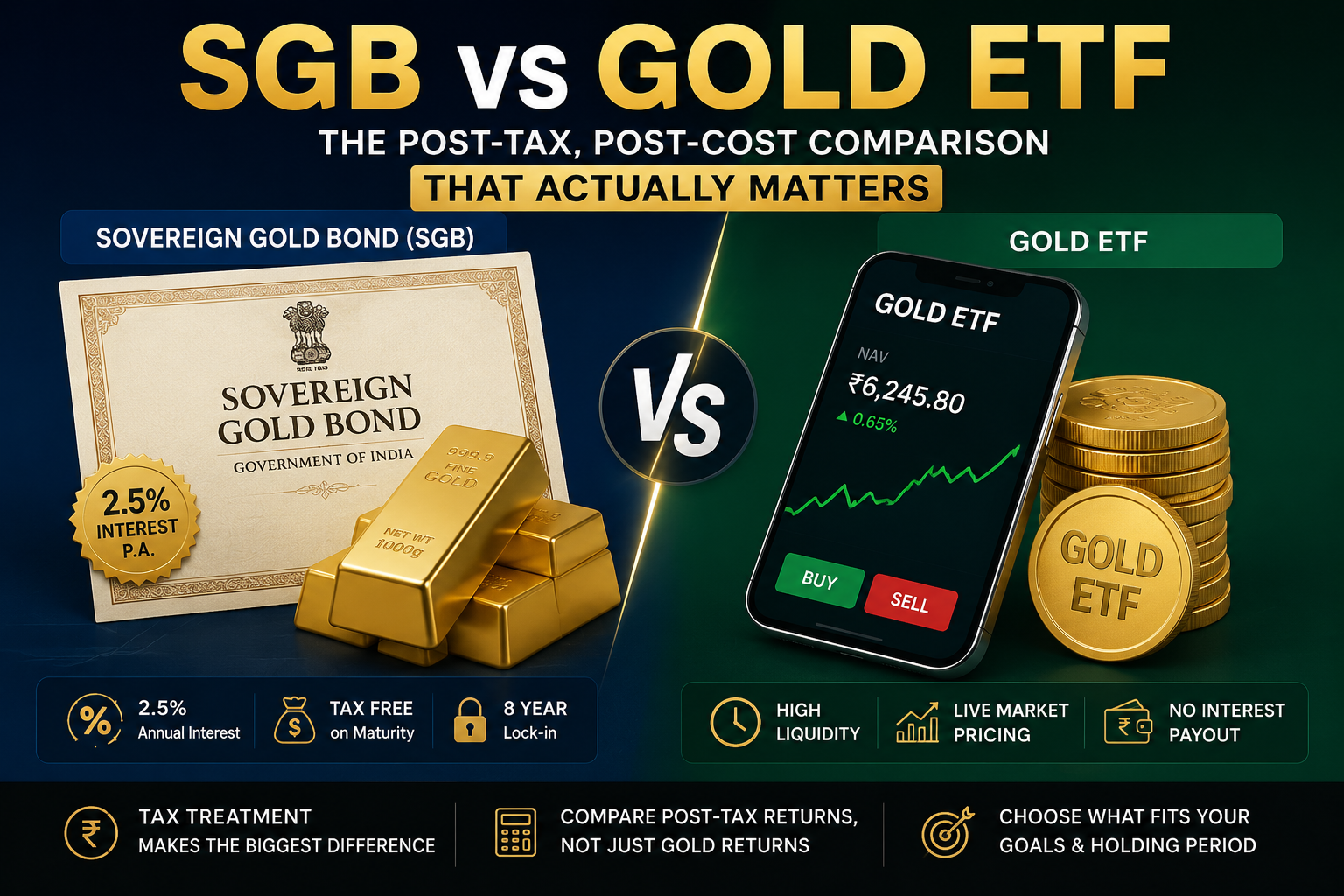
The Digital Gold Dilemma
Every Indian investor who has searched for “SGB vs Gold ETF” has walked into the same trap. One blog says Sovereign Gold Bonds are the only sensible choice because the interest and tax-free maturity make everything else look foolish. The next says Gold ETFs are superior because you can exit in seconds without the lock-in and the secondary market discount. Both sound convincing. They cite numbers.
And both leave you exactly where you started: paralysed, with money sitting in a savings account while gold inches higher.
The paralysis is expensive. Pick the wrong instrument for your holding period and tax bracket, and the government takes a cut that can erase years of gold’s upside.
Sell a Gold ETF within three years and short-term capital gains get added to your income, taxed at your slab rate: for a 30% bracket investor, that’s nearly a third of the gain gone.
Buy an SGB, need the money in year four, and discover the secondary market is offering you a price 2% below the actual gold value.
These are not edge cases. They are the default outcomes when you choose based on a blog that compared pre-tax returns.
I’ve held both SGBs and Gold ETFs through multiple market cycles.
| Example: Imagine an investor who bought both Gold ETFs and Sovereign Gold Bonds (SGBs) as part of a long-term gold allocation strategy. A few years later, an unexpected expense came up and cash was needed quickly. The Gold ETF units were sold during market hours, and the funds were available without much difficulty. The SGB investment was a different story. Although the bonds could be sold on the stock exchange before maturity, the market price was trading at a discount to the actual gold value at that time. Selling immediately would have meant accepting a lower price than expected. This example highlights one of the biggest differences between Gold ETFs and SGBs. Gold ETFs generally offer better liquidity, while SGBs may reward investors who can stay invested until maturity and take advantage of the additional interest income and tax benefits. |
The only comparison that matters is post-tax, post-cost, and post-liquidity-adjusted. Pre-tax NAV charts are a fantasy.
This guide is built to give you the one thing those blogs don’t: a decision framework that runs the real numbers for your income tax slab, your likely holding period, and the actual exit costs you’ll face. No generic tips or “gold is a hedge” filler. Just the tax math, the liquidity trade-offs, and the holding-period logic that determines which instrument leaves more money in your pocket.
| KEY TAKEAWAYS• SGB’s tax-free maturity redemption and 2.5% annual interest make it the clear winner for 8-year holds, if you can stomach the lock-in.• Gold ETFs win on liquidity, not post-tax returns: selling within 3 years triggers slab-rate STCG, which can wipe out 30% of gains.• SGB secondary market is thin; expect a 1–3% discount to NAV if you exit before the RBI buyback window opens.• For 30% bracket investors, SGB’s indexation benefit on LTCG (sold after 3 years) can cut taxable gains by roughly 25–30% vs. an unindexed ETF sale.• A 70:30 SGB-to-ETF split gives you tax-efficient core holding plus tactical liquidity. |
Before you can compare the tax outcomes, you need to understand what each instrument actually is, starting with the one backed by the Government of India.
Now let’s look at the instrument built for flexibility.
What is a Gold ETF?
SGBs are built for patience. Now let’s look at the instrument built for flexibility.
Exchange-Traded Funds Tracking Physical Gold
A Gold ETF is an open-ended mutual fund scheme that holds physical gold of 995 purity in secure vaults. Each unit typically represents 1 gram of gold, and the Net Asset Value (NAV) moves in lockstep with the domestic gold price. You buy and sell units on the NSE or BSE through your broker, just like a share. The units sit in your demat account, and ownership is clean: broker failure does not touch your holdings.
Behind the scenes, the Asset Management Company (AMC) appoints a custodian to store the bullion. SEBI mandates half-yearly physical verification of that gold by statutory auditors, with reports submitted to trustees. The 2021 circular tightened vault manager and disclosure norms further. This is not a paper promise: it’s audited metal.
Costs, Liquidity, and Market Mechanics
Gold ETFs pay no interest. Your return is purely gold price appreciation minus costs. And those costs come in layers.
The first is the expense ratio, a fee of 0.5% to 1% deducted daily from the NAV. It is silent and relentless. Over a five-year hold, a 1% expense ratio quietly shaves off roughly 5% of your gold exposure. SGBs, by contrast, carry zero recurring cost: a structural difference that compounds.
Then there is brokerage on every buy and sell, plus the bid-ask spread. During calm markets the spread is tight, but it widens when gold moves fast.
| While Gold ETFs usually track the value of gold closely, the price you see on the stock exchange can sometimes be slightly different from the fund’s actual NAV. During busy trading periods or sharp gold price movements, the gap may become a little wider, which can slightly increase your buying or selling cost. It’s usually not a major issue, but it’s something investors should be aware of. |
Liquidity is intraday, which is the ETF’s signature advantage. You can exit at 11:17 a.m. on a Tuesday. But that flexibility has a price tag, especially for small or frequent trades.
| EXPERT TIP Choose a Gold ETF with an expense ratio below 0.5% and AUM over ₹100 crore; this keeps tracking error tight and bid-ask spreads narrow. |
| When comparing Gold ETFs, don’t focus only on past returns. It’s also worth checking the fund’s expense ratio and assets under management (AUM). A lower expense ratio means less of your investment goes toward annual fees, while a larger AUM can indicate better liquidity and investor interest. As a starting point, many investors look for Gold ETFs with a reasonably low expense ratio and a well-established asset base before comparing other factors. |
Regulatory Framework and Safety
Gold ETFs operate under SEBI’s mutual fund regulations. The custodian holds the physical gold, and the AMC must adhere to strict transparency and audit requirements. The half-yearly physical verification requirement, in place since 2010, means an independent auditor counts the bars and reports to trustees. The 2021 circular added further safeguards around vault managers and disclosures.
This is a fundamentally different safety profile from an SGB. An SGB carries a sovereign guarantee, the Government of India stands behind it, and there is no credit risk. A Gold ETF carries AMC operational risk and broker stability risk. Those risks are remote, but they are not zero. SEBI’s custodian and audit rules mitigate them, yet they remain a layer you accept in exchange for intraday liquidity.
Now you know what each instrument is. Let’s put them side by side so the differences become impossible to miss.
Key Differences at a Glance
Now that you know what each instrument is, let’s put them side by side so the differences become impossible to miss.
| Feature | Sovereign Gold Bond (SGB) | Gold ETF | |
| Issuer | Government of India (Reserve Bank of India) | Asset management company (e.g., Nippon India, SBI, HDFC) | |
| Minimum Investment | 1 gram of gold | 1 unit (typically ~0.01 gram of gold) | |
| Tenor | 8 years; premature redemption allowed only from 5th year via RBI buyback windows | No fixed tenor; units can be held indefinitely | |
| Annual Returns | Gold price appreciation + 2.50% p.a. fixed interest paid semi-annually | Gold price appreciation minus expense ratio (0.4%–1% p.a.) | |
| Liquidity | Low before 5th year. Secondary market sale possible on NSE/BSE but typically at a 1–3% discount to NAV | High. Units can be bought or sold on the exchange at real-time NAV during market hours | |
| Transaction Costs | No entry load. Exit via secondary market incurs brokerage and the discount spread | Brokerage and securities transaction tax (STT) on sale; no entry load for most ETFs | |
| Tax on Gold Appreciation at Maturity | *Tax-exempt* (fully exempt from capital gains tax) | Taxable. LTCG at 20% with indexation if held >3 years | |
| Tax on Sale Before 3 Years | STCG at investor’s slab rate (if sold on secondary market before 3 years) | STCG at investor’s slab rate | |
| Tax on Sale After 3 Years | LTCG at 20% with indexation (if sold on secondary market after 3 years but before maturity) | LTCG at 20% with indexation | |
| Safety | Sovereign guarantee, no credit risk | Backed by physical gold held by a custodian; fund-house and custodian risk exist, though minimal in practice | |
| Ideal Holding Period | Until maturity (8 years) to capture the tax-free exit | Over 3 years to qualify for indexation benefit; no tax advantage at maturity | |
The table highlights the single most mispriced difference: SGB maturity gains are tax-exempt, whereas ETF gains incur either STCG at slab rates or LTCG at 20% with indexation. That tax asymmetry alone can swing the post-tax return by several percentage points over a full cycle.
SGB’s 2.5% interest is a taxable cash flow that ETFs don’t offer, making it a drag for high-slab investors unless offset by the tax-free maturity. Liquidity is the hidden cost. An SGB premature exit requires a secondary-market sale at a typical 1–3% discount, whereas ETF units can be sold instantly at NAV.
The sovereign guarantee eliminates credit risk for SGB, but ETF investors rely on the fund house and custodian, a distinction that matters only during systemic stress.
The table tells you what’s different. The next section tells you what those differences cost you in rupees.
Tax Implications Deep Dive
The table tells you what’s different. The next section tells you what those differences cost you in rupees.
How SGB Interest and Capital Gains Are Taxed
SGBs pay 2.5% interest per year, credited semi-annually. That interest is taxable as ‘Income from Other Sources’ at your slab rate. For a 30% bracket investor, ₹5,000 of annual interest on a ₹2 lakh investment shrinks to ₹3,500 after tax. It’s a drag, but not the main event.
The main event is what happens to the capital gains. Hold an SGB to its 8-year maturity, and the redemption proceeds are fully exempt from capital gains tax. No LTCG, no indexation needed, the government simply doesn’t tax the gain. That’s a rare gift in Indian taxation.
Sell before maturity on the secondary market, and the tax treatment depends on your holding period. Held for more than 3 years, gains qualify as long-term capital gains (LTCG) taxed at 20% with indexation. Held for 3 years or less, they’re short-term capital gains (STCG) taxed at your slab rate, the same trap that catches ETF investors.
Gold ETF Taxation: The Short-Term Trap
Gold ETFs are brutally simple. Sell units within 3 years of purchase, and every rupee of gain is added to your income and taxed at your slab rate. For a 30% taxpayer, that’s a 30% haircut on the profit. Compare that to the 20% LTCG rate with indexation that applies after 3 years, and the short-term trap becomes a wealth destroyer.
Let’s put numbers on it. Invest ₹1 lakh in a Gold ETF. Gold appreciates at 12% annually. After 2 years, the investment grows to ₹1,25,440.
Subtract the 0.5% expense ratio (roughly ₹1,200 over two years) and ₹40 in brokerage, and the pre-tax gain is about ₹24,200. A 30% bracket investor pays ₹7,260 in STCG tax, leaving a net corpus of ₹1,18,180.
DIFFERENTIATION OPPORTUNITY
Many investors compare Gold ETFs and SGBs based on gold returns alone. However, the bigger difference often comes from taxation. For investors in higher tax brackets, the tax treatment of SGBs can result in significantly higher post-tax returns than a Gold ETF sold during the short-term capital gains period. This is why comparing post-tax returns is often more important than comparing gold price performance alone.
Now consider an SGB bought at the same time but held for 5 years and sold on the secondary market. The same 12% annual gold appreciation pushes the value to ₹1,76,234.
Indexation inflates the purchase price using the Cost Inflation Index, slashing the taxable gain. The net post-tax corpus, even after paying 20% LTCG tax and interest tax, lands well above ₹1,50,000. The STCG trap on ETFs isn’t a minor detail, it’s a structural disadvantage for anyone in the 20% or 30% bracket.
Post-Tax Return Calculations by Income Bracket
The table below calculates the net post-tax corpus for a ₹2 lakh investment across three tax brackets. It factors in every cost that lazy comparisons ignore: interest tax on SGBs, expense ratio and brokerage on ETFs, and the correct capital gains treatment for each instrument.
| Tax Bracket | Instrument | Holding Period | Gross Return | Interest Tax Drag | Brokerage + Expense Ratio | Capital Gains Tax | Net Post-Tax Corpus | |
| 5% Bracket | SGB | 5 years (maturity) | ₹3,18,860 | ₹1,250 | ₹20 | ₹0 | ₹3,17,590 | |
| 5% Bracket | ETF | 2 years | ₹2,33,280 | ₹0 | ₹2,195 | ₹1,554 | ₹2,29,531 | |
| 20% Bracket | SGB | 5 years (maturity) | ₹3,18,860 | ₹5,000 | ₹20 | ₹0 | ₹3,13,840 | |
| 20% Bracket | ETF | 2 years | ₹2,33,280 | ₹0 | ₹2,195 | ₹6,217 | ₹2,24,868 | |
| 30% Bracket | SGB | 5 years (maturity) | ₹3,18,860 | ₹7,500 | ₹20 | ₹0 | ₹3,11,340 | |
| 30% Bracket | ETF | 2 years | ₹2,33,280 | ₹0 | ₹2,195 | ₹9,325 | ₹2,21,760 | |
Assumptions: ₹2 lakh investment, 8% annual gold appreciation, ₹20 flat brokerage per trade, 0.5% ETF expense ratio, interest taxed at slab rate. SGB held to maturity (5 years for illustration) with no brokerage on redemption; ETF sold after 2 years to trigger STCG.
The gap is stark. For a 30% bracket investor, the SGB maturity route delivers nearly ₹90,000 more than the short-term ETF sale. Even in the 5% bracket, the SGB advantage is over ₹88,000. The tax code isn’t neutral, it actively favors the patient, long-term SGB holder.
Indexation Benefits Explained
Indexation is the mechanism that makes SGBs sold before maturity still competitive. It adjusts your purchase price for inflation using the government’s Cost Inflation Index (CII), reducing the taxable gain.
Here’s how it works. Suppose you bought an SGB in FY 2019-20 for ₹2 lakh. The CII for that year was 289. You sell in FY 2024-25, when the CII is 363. Your indexed cost becomes ₹2,00,000 × (363/289) = ₹2,51,211.
If gold appreciated by 8% annually over those 5 years, the sale value would be ₹2,93,860. The taxable LTCG is ₹2,93,860 – ₹2,51,211 = ₹42,649. At 20% tax, you pay ₹8,530, an effective tax rate of just 2.9% on the total corpus, or about 9.1% on the real gain.
Without indexation, the gain would be ₹93,860, and tax ₹18,772. Indexation saves you ₹10,242 in this single transaction.
| EXPERT TIP: For 30% bracket investors, SGBs’ indexation benefit on secondary-market LTCG can slash the effective tax rate to ~10% vs. 30% STCG on ETFs. |
This is why holding period matters more than the instrument. An SGB sold after 3 years and a day gets indexation; an ETF sold after 2 years and 364 days gets the slab-rate hammer.
Taxes aren’t the only thing that can eat your returns. Liquidity, or the lack of it, can do equal damage when you need cash urgently.
Liquidity and Exit Options
Taxes aren’t the only thing that can eat your returns. Liquidity, or the lack of it, can do equal damage when you need cash urgently. Most comparisons treat SGBs and Gold ETFs as interchangeable stores of gold value. They aren’t.
One locks you in for years; the other lets you walk out any trading day. The difference isn’t theoretical. It shows up in rupees the moment you need to sell before a planned maturity.
SGB Early Redemption and Secondary Market Realities
SGBs are designed for an 8-year hold. The RBI allows premature redemption only from the fifth year onward, and only during specific buyback windows it announces. Before that, you cannot walk up to the issuing bank and ask for your money back. Your only exit is the secondary market on NSE or BSE, where you sell your bond to another investor.
That market is thin. SGBs often trade at a 1–3% discount to the underlying gold NAV because there aren’t enough buyers to absorb a sudden sell order. The discount is a hidden exit cost most blogs ignore.
They quote the gold price and call it a day. But when you actually place a sell order, the price you get is lower, sometimes much lower, than what the gold inside the bond is worth.
| EXPERT TIP: Buy SGBs at the primary issue price to avoid the 1–3% discount common on secondary market purchases. |
The discount isn’t a theoretical spread. It’s a real transfer of value from a forced seller to a patient buyer. If you’re the one who needs cash, you pay that toll.
Gold ETF: Selling Any Trading Day
A Gold ETF has no lock-in. You can sell your units on any trading day between 9:15 AM and 3:30 PM IST. The order executes at the prevailing market price, which closely tracks the physical gold price. Funds settle T+1 or T+2 and land in your bank account.
No RBI window. No premium or discount negotiation. No waiting for a buyer to show up.
This is the ETF’s single biggest structural advantage. It doesn’t matter whether you’ve held the units for three weeks or three years. The exit mechanism is identical.
The only friction is the brokerage fee on the sell order and, if held for less than three years, the short-term capital gains tax added to your income. There is no lock-in penalty, no hidden spread beyond the normal bid-ask, and no risk of a 3% haircut because the market is asleep.
| EXPERT TIP: For goals under 3 years, Gold ETFs let you exit any trading day with T+1 settlement and no lock-in penalty, unlike SGBs. |
The Financial Impact of Emergency Exits
Let’s make the asymmetry concrete. Suppose you need ₹2 lakh urgently in year three. You hold gold worth exactly that amount in both instruments.
With the Gold ETF, you sell units. Brokerage on a ₹2 lakh sell order at a discount broker is typically ₹20 or less. If you’ve held for less than three years, the gain is added to your income and taxed at your slab rate. The exit cost is brokerage plus STCG tax, under 1% of the capital for most investors, and often far less.
With the SGB, you cannot redeem from the RBI. You must sell on the secondary market. The bond’s underlying gold value is ₹2 lakh, but the market price you receive will likely be 1–3% lower. That’s ₹2,000 to ₹6,000 gone before you even account for brokerage.
Add another ₹20–50 in brokerage, and your total exit cost lands between 1% and 3% of the capital, possibly more if liquidity is especially poor that day.
The rupee damage is not trivial. A 2% discount on a ₹2 lakh exit is ₹4,000. That’s real money you never see again. It’s the price of a lock-in you didn’t think would matter, until it does.
Liquidity has a price. But so does simply holding the instrument. Let’s add up every cost you’ll actually pay.
Costs on paper are one thing. Let’s see how they played out in the real world, with a ₹1 lakh investment made in 2019 and tracked to today.
For the latest information on Sovereign Gold Bonds, investors can refer to the official RBI resources and notifications published by the Reserve Bank of India.
For Gold ETF regulations and investor protection measures, SEBI’s mutual fund regulations and circulars provide detailed guidance on fund operations, custody requirements, and disclosures.
For official information on Sovereign Gold Bonds, investors can refer to the Reserve Bank of India (RBI) website. Gold ETF regulations, custody requirements, and investor protection measures are governed by the Securities and Exchange Board of India (SEBI). Reviewing these official resources can help investors understand the regulatory framework behind both investment options.
Real-Life Performance: The 2019 Simulator
Costs on paper are one thing. Let’s see how they played out in the real world, with a ₹1 lakh investment made in 2019 and tracked to today.
The Setup: ₹1 Lakh Each in SGB and ETF
In February 2020, the RBI issued Sovereign Gold Bond Series IX at ₹4,020 per gram (online price after the ₹50 discount). An investor putting ₹1 lakh into that tranche got 24.88 grams of gold, backed by a sovereign guarantee and a fixed 2.5% annual interest payout.
Another investor took the same ₹1 lakh and bought units of a Gold ETF at roughly the same spot price of ₹4,020 per gram, gaining exposure to 24.88 grams of gold minus the fund’s expense ratio, which we’ll peg at 0.5%, a typical figure for Indian Gold ETFs.
Both started with identical gold exposure. The divergence came from three structural forces: interest, expense drag, and tax treatment.
Investor Profile 1: The Long-Term SGB Holder
Investor A held the SGB through to early 2025. By January 2025, the RBI’s premature redemption price for that series stood at ₹7,825 per gram. The 24.88 grams were now worth ₹1,94,686. That ₹94,686 gain? Entirely tax-free if held to maturity. The SGB’s tax-free maturity gain is the single biggest differentiator: not the interest, not the sovereign guarantee.
Meanwhile, the bond paid ₹2,500 in interest every year. Over five years, that’s ₹12,500 pre-tax. For an investor in the 30% slab, after-tax interest adds ₹8,750 to the corpus. Total post-tax value: ₹2,03,436. A ₹1 lakh investment turned into over ₹2 lakh after taxes, with zero capital gains leakage.
| EXPERT TIP SGB’s ₹2,500 annual interest per lakh compounds to over ₹20,000 pre-tax over 8 years, a return stream ETFs cannot replicate. |
Investor Profile 2: The ETF Trader
Investor B’s ETF journey was quieter but costlier. The 0.5% expense ratio, deducted daily from the NAV, shaved off gold exposure year after year. After five years, the effective gold held dropped to 24.26 grams. At ₹7,825 per gram, the ETF’s value stood at ₹1,89,834, a pre-tax gain of ₹89,834.
Now the taxman steps in. Since the holding period exceeded three years, the gain qualifies as long-term capital gains with indexation benefit. The purchase cost of ₹1,00,000 is inflated using the Cost Inflation Index: 363 (FY 2024-25) divided by 289 (FY 2019-20) gives an indexed cost of ₹1,25,600.
Taxable gain: ₹64,234. At 20% LTCG rate, the tax bill is ₹12,847. Post-tax corpus: ₹1,76,987.
The ETF’s expense ratio silently erodes 0.5% annually, compounding to a 2.5% pre-tax drag over 5 years. If Investor B had sold in year two during a volatility spike, short-term capital gains at the 30% slab rate would have wiped out an even larger chunk.
| EXPERT TIPA 70:30 SGB-to-ETF split gives you tax-free core gains plus liquid tactical exposure without sacrificing the interest advantage. |
What the Numbers Reveal
Place the two post-tax corpuses side by side: ₹2,03,436 for the SGB holder versus ₹1,76,987 for the ETF holder. That’s a 15% advantage, purely from structural design, not market timing. The SGB investor collected tax-free gold appreciation and after-tax interest; the ETF investor paid an invisible expense ratio and then surrendered a slice of gains to the tax department.
The numbers don’t lie. But numbers alone don’t make your decision. Your financial personality does. Here’s how to match the instrument to who you actually are as an investor.
Which One Should You Choose? A Decision Framework
The numbers don’t lie. But numbers alone don’t make your decision: your financial personality does. Here’s how to match the instrument to who you actually are as an investor.
The Investor Decision Matrix
| Investor Profile | Recommended Instrument | Rationale | |
| Long-term wealth builder (8+ year horizon) | SGB | *Tax-free redemption* at maturity eliminates the largest cost. The 2.5% interest is a small sweetener, and sovereign guarantee removes credit risk. The illiquid window before year 5 is the price you pay for that tax shield. | |
| Short-term trader or emergency fund holder (1–3 years) | Gold ETF | Daily liquidity is non-negotiable. STCG at your slab rate will dominate returns: the ETF’s expense ratio is the least of your worries. Use it only if you accept the tax hit. | |
| High-tax-bracket earner (30% slab) | SGB | LTCG exemption after 3 years (and full exemption at maturity) makes SGB the clear winner. The 2.5% interest, net 1.75% after tax, is still positive, but the real payoff is the tax-free capital gain. | |
| Conservative first-time gold investor | SGB (if you can commit to 5+ years) | Sovereign guarantee, zero expense ratio, and no tracking error. The trade-off: you cannot exit before year 5 without a secondary-market discount. If you need liquidity sooner, choose the ETF and accept the tax cost. | |
| Tactical asset allocator | Gold ETF | You need to rebalance quarterly or annually. SGB’s lock-in and secondary-market friction make it unusable for active allocation. ETF units redeem at NAV in T+2: clean and predictable. | |
| Investor seeking passive income from gold | SGB | The 2.5% semi-annual interest provides a small, taxable income stream. Gold ETFs pay nothing. This is a niche use case, but for someone who wants gold exposure plus a trickle of cash flow, SGB fits. | |
Scenario-Based Recommendations
Child’s education in 8 years. The horizon aligns perfectly with SGB’s 8-year tenor. You get tax-free redemption, 2.5% annual interest along the way, and zero expense drag. The illiquid window doesn’t matter because you won’t touch the money before year 5. SGB is the unambiguous choice.
House down payment in 2 years. You need the money soon and you need it liquid. A Gold ETF gives you daily exit at NAV. Yes, STCG at your slab rate will bite, but that’s the cost of short-term gold exposure. SGB’s lock-in makes it impossible for this goal.
30% bracket investor who maxes out 80C. Your marginal tax rate is high, so tax-free capital gains are disproportionately valuable. SGB’s LTCG exemption (and full exemption at maturity) shields the bulk of your return. The 2.5% interest, net 1.75%, is a minor add-on: the real win is what you don’t pay in tax. SGB is the tax-efficient anchor for this profile.
You’ve made your choice. Now here’s exactly how to execute it: step by step, no gaps.
Getting Started: Practical Steps
You’ve made your choice. Now here’s exactly how to execute it: step by step, no gaps. The process for SGBs and Gold ETFs is different enough that mixing them up will cost you time. So I’ll lay out each path separately, then cover the one thing both require: nomination.
How to Invest in SGBs
How to Invest in SGBs
At present, the Government of India is not issuing new Sovereign Gold Bonds (SGBs). However, investors can still buy existing SGBs through the secondary market on the NSE or BSE.
Here’s how to get started:
- Open a demat and trading account with a stockbroker if you don’t already have one.
- Search for listed SGBs on the NSE or BSE. Different SGB series trade at different prices and have different maturity dates.
- Compare the remaining maturity period, market price, and liquidity before investing. Some bonds may trade at a discount or premium to their intrinsic gold value.
- Place a buy order through your broker just like you would purchase a stock or ETF. The units will be credited to your demat account after settlement.
- Register a nominee with your demat account to ensure a smooth transfer of assets to your family if needed.
If the government resumes fresh SGB issuances in the future, investors will be able to apply through banks, stockbrokers, post offices, or the RBI Retail Direct platform during the subscription window.
How to Buy Gold ETFs
Gold ETF liquidity varies by fund. Before you buy, check the average daily volume on the NSE to ensure you can exit without slippage. Here’s the execution path:
1. Open a demat + trading account with a discount broker. You need both. A trading account alone won’t hold ETF units.
2. Compare Gold ETF expense ratios on Value Research Online or AMFI. A 0.1% difference compounds silently; over 8 years, it can erode returns by roughly 1%. Pick a fund with a low expense ratio and decent AUM.
3. Place a buy order during market hours using the ETF ticker. Use a limit order, not a market order, to control the price. The order settles T+2, and units appear in your demat.
4. Monitor tracking error quarterly. The ETF’s NAV should mirror domestic gold price. If the gap widens persistently, consider switching to a better-managed fund.
5. Sell via the trading platform when needed. The same broker interface lets you exit. Pay attention to the bid-ask spread; a wide spread eats into your exit price.
Documentation and Nomination
Both instruments demand the same KYC basics: PAN, Aadhaar, and a cancelled cheque. Keep them handy.
For SGBs, nomination happens at the RBI or bank level, depending on where you hold the bond. For ETFs, nomination is done through your demat account form; file it with your depository participant (DP). Do not assume your broker handles this automatically.
Why nomination matters: without it, your family must navigate probate to claim the asset. That’s a slow, expensive process in India. A five-minute nomination form now saves them months of legal hassle later.
You know how to buy. But what about the worst-case scenarios? Let’s talk about what happens if things go wrong.
Safety, Sovereign Guarantee, and What-Ifs
You know how to buy. But what about the worst-case scenarios? Let’s talk about what happens if things go wrong.
Is My Gold ETF Safe if the Broker Fails?
The short answer: yes, your ETF units are not on the broker’s books. They sit in your demat account with NSDL or CDSL, the twoA broker is just an intermediary. If the broker shuts down, your units remain untouched in your demat account. You simply open a new account with another broker and transfer the holdings across. The real-world stress test came in March 2020, when market panic and margin calls strained several brokerages.
The larger, though far less likely, risk is an AMC-level operational failure. Could the asset management company running your Gold ETF collapse? SEBI’s rules make this extremely difficult. Every Gold ETF must appoint an independent custodian (a scheduled bank) that holds the physical gold. SEBI mandates half-yearly physical verification of that gold by statutory auditors, with reports submitted to the fund’s trustees.
The AMC never directly handles the bullion. Fraud would require collusion between the AMC, the custodian, and the auditor, a remote scenario, not a zero one, but heavily mitigated.
SGB Default Risk: Theoretical vs Practical
SGBs carry a sovereign guarantee. The Government of India is the counterparty. For you to lose your principal, the Indian sovereign would have to default on its domestic obligations. That is not a corporate credit event; it is a full-blown sovereign debt crisis.
In practical terms, this is the safest credit exposure available to an Indian retail investor, safer than any bank fixed deposit, which carries DICGC insurance only up to ₹5 lakh.
The contrast with a Gold ETF is instructive. An ETF’s safety rests on a chain of regulated entities: the AMC, the custodian, the trustee, and the auditor. Each link is strong, but the chain has more links. An SGB’s safety rests on a single, direct promise from the sovereign. There is no operational chain to break. The only risk is that the government reneges, and that risk is not a practical one for a domestic rupee bond.
We’ve covered every angle. Time to land the plane.
Conclusion
We’ve covered every angle. Time to land the plane.
The real question isn’t “SGB or ETF?” It’s “Which one fits your financial personality?” Most comparisons miss this entirely. They pit pre-tax returns against each other and call it a day. That’s lazy.
If you prize certainty, the SGB is built for you. That sovereign guarantee eliminates credit risk. The 8-year lock-in forces discipline, and the tax-free redemption on maturity is a genuine edge. You sleep well knowing exactly what you’ll get, when you’ll get it. The trade-off is liquidity. You cannot exit early without taking a secondary market discount, typically 1–3% against the seller.
If you need flexibility, the Gold ETF is your instrument. You can sell in seconds during market hours. The expense ratio (0.4%–1%) and tracking error are the price of that liquidity. You accept them because you might need cash next month, next year, or at a moment you cannot predict. The ETF doesn’t judge.
The only comparison that matters is post-tax, post-cost, liquidity-adjusted return over your actual holding period. Not a generic chart. Not a pre-tax fantasy.
Run your numbers. Check your tax bracket. Be honest about liquidity. Then invest.
That’s the comparison that earns its keep.
Important: As of 2026, fresh Sovereign Gold Bond issuances are not currently available. Investors looking for SGB exposure need to buy existing bonds from the secondary market.
Before choosing between an SGB and a Gold ETF, it may help to review the current gold market. You can check our Gold Price Today page for the latest rates and trends.
FAQ
What is the main tax advantage of SGB over Gold ETF?
SGB maturity redemption is fully exempt from capital gains tax, while Gold ETF gains are always taxable (STCG at slab rate if held <3 years, LTCG at 20% with indexation if >3 years).
Can I exit an SGB before 5 years?
Only through the secondary market on NSE/BSE, typically at a 1-3% discount to the underlying gold NAV. RBI premature redemption is allowed only from the 5th year via specific buyback windows.
Which is better for a short-term goal of 1-3 years?
Gold ETF, because it offers daily liquidity. However, gains are taxed as short-term capital gains at your income slab rate, which can significantly reduce returns.
How does indexation reduce tax on SGB sold before maturity?
Indexation inflates the purchase price using the Cost Inflation Index, reducing the taxable long-term capital gain. For example, a 5-year hold can cut effective tax rate to ~10% for a 30% bracket investor.
Is the 2.5% interest on SGB taxable?
Yes, it is taxed as ‘Income from Other Sources’ at your applicable slab rate. For a 30% bracket investor, net annual interest is 1.75% after tax.